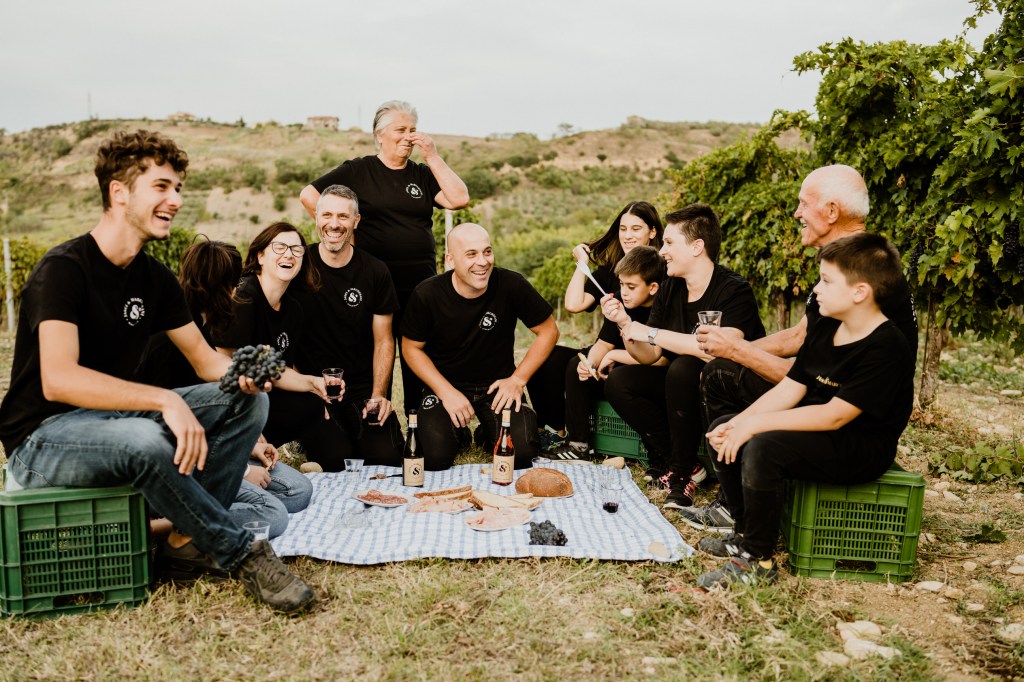
As Australian wine regions increasingly explore sustainable viticulture, it’s interesting to hear from producers who have been practicing organic farming for decades. While “organic” can sometimes feel like a recent shift in Australia, in parts of Italy it has long been a quiet, consistent way of working, shaped more by instinct than by trend. In Abruzzo, along the Adriatic coast, the Jasci family has followed this path for generations.
I recently had the pleasure of speaking with Nicola Jasci, third-generation winemaker at Jasci & Marchesani, whose perspective offers not just an understanding of organic farming, but a sense of how it evolves over time, becoming less a decision and more a rhythm.
A Philosophy Before a Certification
For Nicola, organic farming was never something adopted. It was something inherited.
Although the winery received official certification in 1978, the approach reaches back further, to the 1960s, when his family simply farmed without synthetic chemicals because it felt like the most natural and honest way to work. Certification came later, giving structure to what was already in place.
What stands out is that the decision was never driven by market demand or positioning. It was rooted in a simple idea: that respect for the environment is inseparable from respect for the person drinking the wine. In Australia, where producers are increasingly exploring organic or sustainable pathways, this perspective feels grounding. It shifts the conversation from how to farm organically to why.
Farming as Observation
Organic viticulture often sounds straightforward in theory, but in practice it asks for something deeper: attention.
In Abruzzo, where humidity can increase disease pressure, there are no easy solutions. Without synthetic chemicals, the vineyard becomes a place of constant observation. Nicola describes it as a preventative approach, one that depends on being present, reading each vine, and responding at the right moment. Treatments such as copper and sulfur are used carefully and within strict limits. Canopy management becomes essential, not just for growth, but for airflow, light, and the quiet balance that keeps disease at bay.
There is a patience to this way of working. Decisions are not applied broadly, but made in response to what is happening in front of you. It is a mindset that feels increasingly familiar in Australia, as more vineyards move toward lower-intervention farming. What appears to be restraint often requires greater effort, more time in the vineyard, and a closer relationship with the land.
Climate and the Need for Precision
If organic farming asks for attention, climate demands precision.
For Nicola, one of the greatest challenges today is unpredictability. Shifting weather patterns and rising humidity mean that each season brings new pressure, and without the option of quick chemical correction, timing becomes everything.
This is not unique to Abruzzo. Across Australia, growers are navigating similar conditions, where vintages can move quickly and decisions carry greater weight. In this context, organic farming becomes less about ideology and more about responsiveness. It is not about doing less. It is about knowing exactly when to act.
From Vineyard to Glass
What happens in the vineyard carries through, quietly but clearly, into the wine.
For Nicola, organic farming allows for a more transparent expression of place. Wines show cleaner aromatics, more defined acidity, and a stronger connection to their origin. The intention is not to shape the wine into something else, but to allow it to arrive with clarity.
This idea resonates strongly with the direction of Australian wine. Across regions, there is growing interest in wines that feel more precise, more site-driven, and less shaped by heavy-handed intervention. In the cellar, the same philosophy continues. Additions are kept to what is necessary and permitted, supported by technology that helps reduce intervention rather than replace it. Sulphur is used carefully, and processes are refined so that what begins in the vineyard is carried through to the bottle with as little disruption as possible. There is a consistency here, from soil to glass, that feels guided rather than controlled.
A Cultural Shift
One of the most important ideas Nicola shared is that organic conversion is not simply technical. It is cultural.
For producers considering this path, the advice is not about products or processes, but about patience. Organic farming takes time, not just to implement, but to understand. It asks for a deeper connection with the vineyard, and a willingness to accept that results come gradually.
In Australia, where sustainability is increasingly part of the conversation, this distinction matters. Organic farming is not a quick adjustment, but a long-term commitment that reshapes decisions in both the vineyard and the winery.
Organic Wine and the Australian Perspective
Interest in organic wine continues to grow globally, and Australia is no exception. Over the past decade, it has moved from a niche category into a more visible part of the conversation, with steady growth in both production and consumption.
Much of this interest is driven by younger, more environmentally aware drinkers. Yet organic wine still represents a relatively small share of the market, suggesting it is evolving rather than fully established. This makes Nicola’s perspective particularly relevant. Organic farming, he suggests, must go hand in hand with quality and identity. Without that, the philosophy risks losing its meaning.
For Australian producers, the message is clear. Sustainability matters, but the wine must still speak with balance, clarity, and a sense of place.
Final Sip
Speaking with Nicola Jasci, what becomes clear is that organic farming is not something new, but something steady, almost instinctive.
In Australia, it is still finding its place, shaped by region, climate, and philosophy. In Abruzzo, it has already settled into a rhythm, refined over time and guided by experience rather than trend. The connection between the two is not about comparison, but about perspective.
Organic viticulture is not simply a set of practices. It is a way of listening to the vineyard, responding with care, and knowing when to step in and when to step back. Whether in the hills of Abruzzo or the vineyards of Australia, the challenge remains the same: to carry that balance through every decision, until it finds its way into the glass.
 Bush & Barrel
Leave a comment