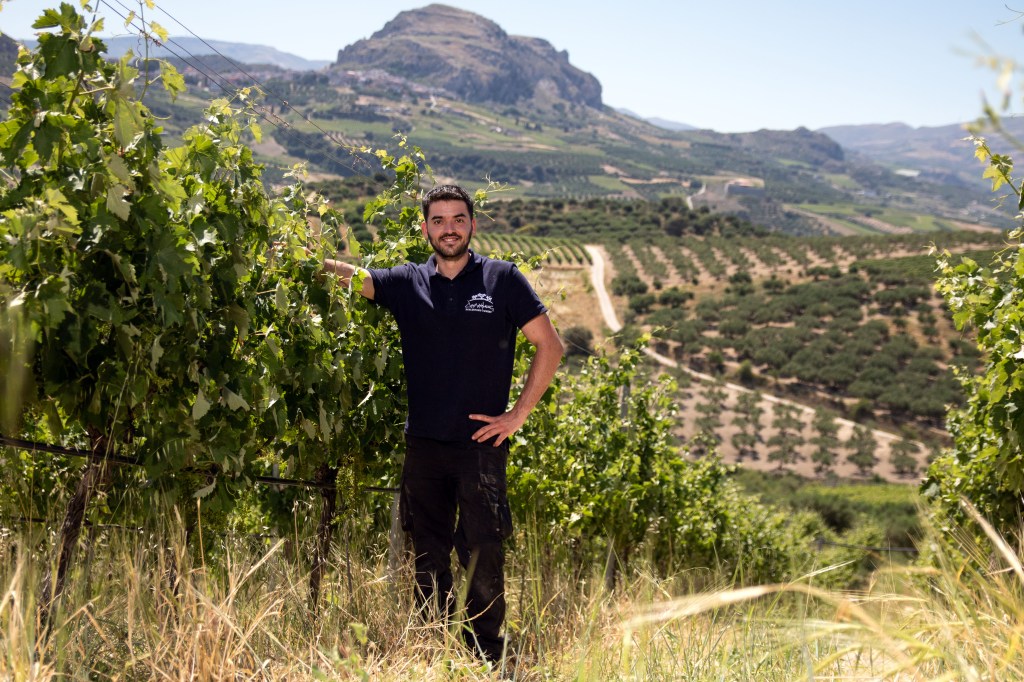
As Australian wine regions continue to explore varieties suited to a warmer future, it is interesting to look beyond familiar grapes and regions. On the Greek island of Crete, growers have spent generations working with heat, drought and rugged landscapes. Their experience offers an interesting perspective for Australia as conversations around vineyard resilience continue to grow.
I first met Ritsa Goula, Sales Director and Oenologist at Douloufakis Winery, during the Greek Wine Trade Tasting Event in Sydney. I had the opportunity to explore several wines from the Douloufakis range. Vidiano and Assyrtiko showed great balance and vibrant acidity, while Liatiko displayed impressive complexity. Following our conversation, Ritsa kindly connected me with Dimitris Douloufakis, whose insights formed the basis of this discussion. Dimitris represents the fourth generation of the family winery. The story of Douloufakis Winery began in 1930, and today the winery continues under the guidance of his father, Nikos Douloufakis, who remains actively involved as Head Oenologist, while Dimitris and his siblings help shape the future of Cretan wine.
Why Does Crete Matter?
Crete is Greece’s largest island, and its vineyards have long been shaped by warm summers, limited rainfall and mountainous terrain. While climate change is creating new challenges around the world, many of the conditions now being discussed in Australia are already familiar in parts of Crete. Water availability remains one of the biggest concerns. Dimitris explained that this is now the third consecutive year of low rainfall in his region, although unusually beneficial rain during April 2026 helped replenish soil moisture ahead of the growing season.
For Australian growers facing similar questions about drought and water security, the challenges sound surprisingly familiar. Yet perhaps the most interesting lesson is not about responding to a single difficult season, but about learning to work within these conditions over time.
Could Vidiano Find a Home in Australia?
One of the most fascinating parts of our discussion centred on Vidiano, an indigenous white variety that has become closely associated with both Crete and Douloufakis Winery. Its story is also a story of revival. Around 2000, Dimitris’ father, Nikos Douloufakis, became interested in the nearly forgotten variety and began searching old vineyards for surviving vines. Years of observation and vineyard work followed, helping bring Vidiano back into prominence. Today it is recognised as one of Greece’s most important indigenous white grapes.
What makes Vidiano particularly interesting from an Australian perspective is its relationship with heat. According to Dimitris, the variety performs exceptionally well under prolonged sunlight exposure and does not easily over-ripen. Even when fruit reaches higher levels of maturity, it avoids developing overly jammy flavours, instead retaining balance while developing a richer texture.
As Australian growers continue to explore varieties suited to warmer conditions, Vidiano raises an intriguing question: could some of tomorrow’s vineyard solutions already exist in regions that have been living with these conditions for centuries?
What Makes Assyrtiko So Interesting?
Assyrtiko may already be familiar to some Australian wine lovers. Dimitris explained that the variety maintains high acidity and low pH even under intense sunlight and high temperatures. This ability to retain freshness under warm conditions has helped make Assyrtiko one of Greece’s most recognised varieties internationally.
Australia has already begun exploring its potential. Assyrtiko is now planted in regions such as Clare Valley, highlighting the growing interest in Mediterranean varieties within Australian vineyards. Dimitris also suggested that limestone-rich soils could be particularly suitable for Vidiano. While every vineyard site is different, it is easy to understand why varieties such as Vidiano and Assyrtiko are attracting increasing attention as growers look toward the future.
Is Altitude Always the Answer?
When discussions turn to climate adaptation, altitude is often presented as part of the solution. Cooler temperatures at higher elevations can help preserve acidity and slow ripening. Yet Dimitris offered a slightly different perspective. While vineyards across Crete are planted between 100 and 800 metres above sea level, he believes that slope orientation and sun exposure can be just as important as altitude itself. At Douloufakis Winery, north-east facing sites are particularly valued.
It is a useful reminder that vineyard resilience is rarely determined by a single factor. Variety, elevation, exposure and local conditions all work together to shape the outcome.
What Makes Liatiko Different?
The conversation also turned to Liatiko, one of Crete’s historic red grape varieties. What makes Liatiko particularly interesting is the contrast between climate and style. Despite thriving in hot and dry conditions, it produces wines defined by elegance and finesse rather than sheer power. In a world where warm-climate reds are often associated with richness and weight, Liatiko offers a different perspective. It suggests that resilience does not necessarily come at the expense of balance.
For Australian growers exploring alternatives to Shiraz or Grenache in warmer regions, varieties such as Liatiko raise interesting possibilities. Dimitris himself expressed curiosity about how the grape might perform under Australian conditions.
Lessons Beyond the Vineyard
Perhaps the most valuable insight from our conversation was not about a specific grape variety at all. When discussing climate change, Dimitris spoke about the importance of combining scientific knowledge with the experience accumulated by previous generations. He recalled severe drought years during the 1970s, reminding us that difficult seasons are not new to growers, even if today’s challenges may look different. Science remains essential, but so too does observation, experience and an understanding of place.
It is a perspective that feels particularly relevant as Australian wine regions continue to navigate an increasingly uncertain future.
Final Sip
Climate resilience is often discussed through new technology, irrigation strategies or alternative grape varieties. Yet my conversation with Dimitris Douloufakis suggested something broader. Resilience begins with understanding place.
From the revival of Vidiano to the continued relevance of Liatiko, Crete offers examples of how varieties, sites and accumulated experience can work together under challenging conditions. For Australia, the lesson may not be to copy what happens in Crete, but to remain open to what regions like Crete can teach us.
As Australian vineyards continue to adapt to a changing climate, some of the most valuable ideas may come from places that have been living with these challenges for generations.


Leave a Reply