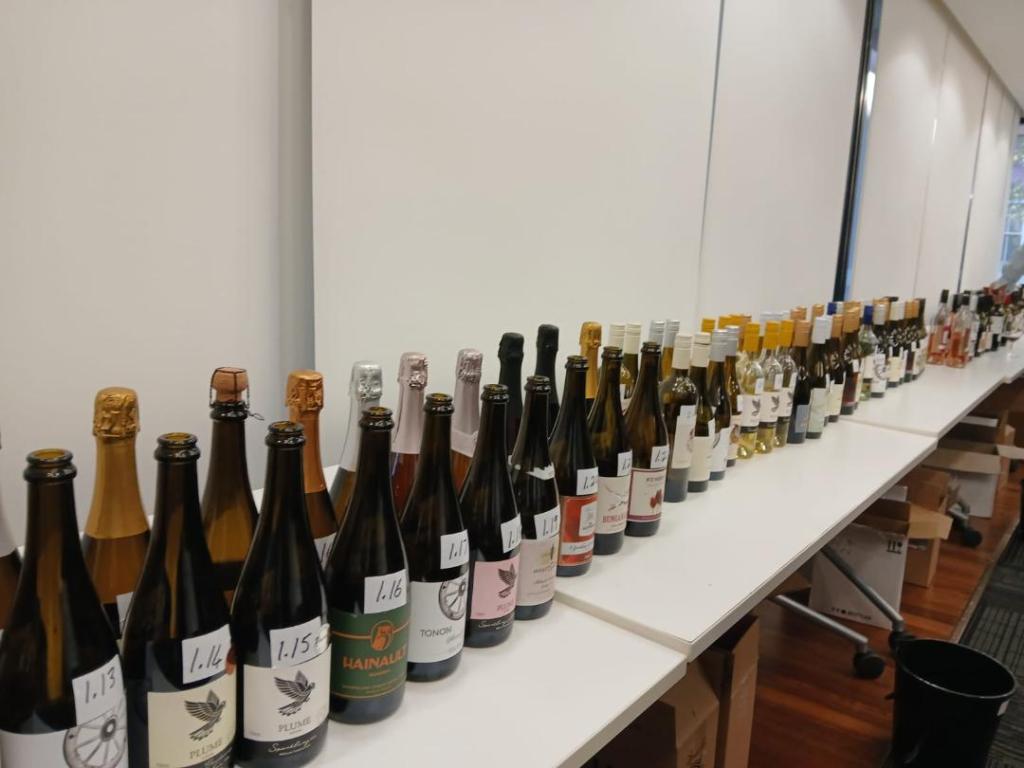
Just 30 minutes from Perth, the Perth Hills is one of Australia’s closest wine regions to a capital city. Its varied elevations and mix of grape varieties came through clearly in the wines entered. The 2026 event was the 27th Perth Hills Wine Show, continuing a tradition spanning more than a quarter of a century.
This show marked an important step in my wine journey. After completing the ASVO Wine Judge Training Course in 2025, I was keen to put that training into practice. The 2026 judging panel was led by Chair of Judges Celine Rousseau (Chief Winemaker at Eden Road), alongside Foni Pollitt (sommelier and WSET educator), Jacopo Dalli Cani (Chief Winemaker at McHenry Hohnen) and me as Associate Judge.
Inside the Judging Room
The experience involved not only tasting the wines but also observing how experienced judges assessed quality, explained their reasoning and reached final decisions as a panel. Each wine was presented blind, identified only by its class and entry number. We assessed the wines independently, recording our scores and comments before any panel discussion. This separation matters because it gives every judge the space to form an opinion without being influenced by someone else’s score or description.
After each class, the scores were reviewed, and wines requiring another look could be called back. A callback is not simply a confirmation of the original score. The wine is tasted again in context, and a judge may see it differently the second time. Temperature, exposure to air and tasting order can affect how a wine presents, while comparison with the strongest wines can sharpen the final assessment.
After judging concluded, the organisers held a feedback session for producers, who were invited to receive their results and discuss how their wines had performed. The session went very well, and the producers were generally pleased with the scores and medals their wines received. It was also a valuable opportunity for the judging panel to hear directly from the producers and better understand their perspectives. The conversations also showed that, whatever the result, there is always something to learn and room to improve.
A Diverse Field of Wines
The show brought together 108 wines from 17 exhibitors across eight classes, covering sparkling wines, dry whites, rosé, Shiraz and Shiraz Viognier, other single red varieties, red blends, sweet and other styles, and wines entered from outside the region.
Medals are not distributed according to a quota. Every wine must earn its result on the day. A class may contain several medal-worthy wines or very few, and the panel’s responsibility is to assess what is in the glass rather than force the results into a predetermined pattern.
The trophy results offered a strong snapshot of the region’s range. Tonon Vineyard & Winery’s 2026 Vermentino was named Best White Wine and Wine of Show. Tonon also received Best Red for its 2025 Xavier Tempranillo. The full list of trophy winners is available on the Perth Hills Wine Region’s Facebook page.
Beyond a Single Signature Variety
These results reflect a region that is not defined by one signature grape. Shiraz remains important, but the success of Vermentino, Tempranillo and Nebbiolo shows how confidently Perth Hills producers are working with alternative varieties.
The region’s varied elevations and growing conditions provide opportunities for producers to explore grapes suited to different sites. Alongside established varieties, these alternative grapes are helping to create a broader regional identity. For me, discovering that diversity was one of the most interesting aspects of the show.
Final Sip
It is easy to say that a wine is enjoyable, but a judge needs to explain why. Fruit definition, structure, texture, balance, complexity and length all contribute to the assessment. Judging requires concentration, consistency and the confidence to support a score with sound reasoning.
The experience introduced me to a region with far greater diversity than many wine drinkers may realise. From Shiraz to Vermentino, Tempranillo and Nebbiolo, the Perth Hills showed genuine variety, character and confidence. It was a memorable first appointment and an experience I hope to build on at future wine shows.
I would also like to thank Wine Show Coordinator Rebekah Wilson, whose careful organisation created a professional, smoothly run judging environment, allowing the panel to focus entirely on the wines.


Leave a Reply